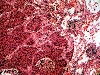
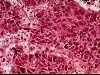
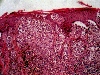
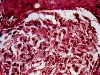
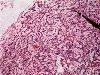
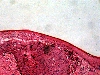
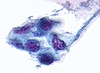
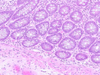
General and Systemic Histopathology, C601&C602 Neoplastic Processes In this laboratory,
we are looking at the principal differences between cells that exhibit normal
cell growth and those that have unregulated or altered growth. It's not the
purpose to study the individual malignancies, rather the process and general
histological appearance. The term "neoplasia" does not necessarily imply
malignancy. It simply means "new growth," and it applies to both benign and
malignant processes. When finished with this laboratory, you should know
what it is meant by the terms: metaplasia, dysplasia and malignancy. When
dealing with the cytological aspects of malignant cells, we talk about the
nuclear/cytoplasmic ratio as well as various degrees of nuclear hyperchromasia
and angulation of the nuclear margins, nuclear molding as well as the mitotic
count. These are more terms you will need to be familiar with. On the histological
level, you will encounter terms such as: gland within gland. Be sure you
can define terms such as carcinoma, sarcoma and adenocarcinoma. You will learn
more specific terms as they apply to the individual systems as we work our
way through the course.
Previous Laboratory | Next Laboratory | Table of Contents
Mark Braun, MD braunm@indiana.edu
|